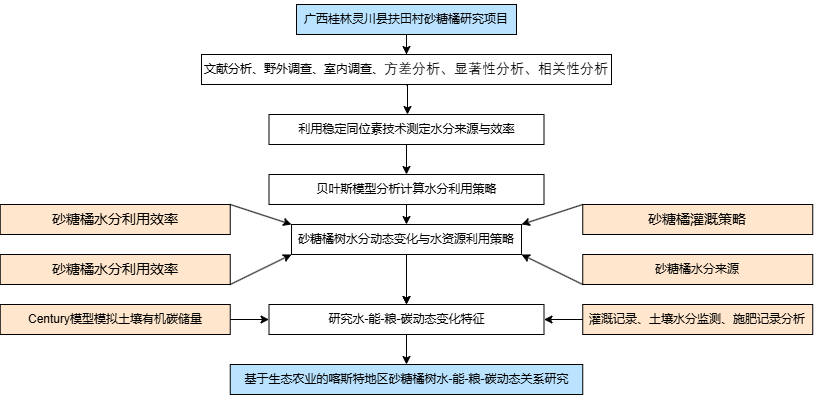
西南喀斯特地区地表地下二元结构明显,地表水渗漏、地下水深埋,即使降水充沛,但依然存在严重季节性干旱,土层浅薄、分布不连续,储水能力低,因此,水分亏缺是西南喀斯特地区植被迅速恢复与生态重建的主要障碍[1-3]。喀斯特地区特殊的地质背景和复杂的地形地貌,水分运移过程有别于其他地区,且不同类型喀斯特地貌类型土壤水分运移规律差异也很大[4-5]。喀斯特地区水资源的合理开发利用和生态环境保护[6],对深刻理解其生态水文过程有着极大的诉求。虽然喀斯特地区生态水文学在植被水分来源与耗散机理、坡面水文过程、环境变化的生态水文效应等方面取得了重要进展,并构建了多种模型[7-9],但在喀斯特地区植被-水分-土壤的耦合关系的响应机制方面的研究较少,无法为喀斯特地区生态治理、环境保护和水资源合理利用等提供更有利的理论依据和技术支撑。
近年来,随着研究方法和观测手段的不断改进和日趋完善,特别是由于稳定同位素技术的快速发展和应用,为深入开展水分限制生态系统中植物对水分资源的利用、混生群落中物种间对水资源的竞争和共生关系以及根系对土壤水分的调节机理的研究提供了一种新的有效途径。氢氧同位素在水循环过程中存在分馏现象而产生不同的氢氧同位素值,可以作为水分迁移的天然示踪剂[16],用于确定植物吸收土壤水分的来源[17-18],在我国喀斯特地区环境特殊,生态水文过程对改善生态环境起着不可忽视作用,喀斯特地区土层浅薄,适用于其它区域的植物与水分之间关系的研究方法,在这一区域并不适用,而稳定同位素技术解决了这一难题;生长在这一区域的植物根系发达,它们对水分利用具有季节性变化,雨季时会利用浅表层土壤水,但旱季时利用表层岩溶带水或深层土壤水[19-20]。随着生态建设的加强,人工种植植被与水资源之间需要维持一个可持续发展的关系,氢氧稳定同位素技术可为植被恢复的物种选择提供可靠的方法,使其合理利用水资源,真正改善区域的生态水文环境。
主要参考文献
1.王亚琳,周秋文,谢雪梅,严卫红,彭大为,韦小茶,唐欣,袁二双. 湿润喀斯特地区冬季灌丛土壤水分对降雨的响应[J]. 水资源与水工程学报,2021,32(06):229-235.
2.杨志成,柯奇画,马芊红,曹梓豪,张科利. 喀斯特地区黄壤坡面土壤水分对降雨的响应[J]. 水土保持学报,2021,35(02):75-79.
3.Feixia Zhong, Xianli Xu, Zhenwei Li, Xiangming Zeng, Ruzhou Yi, Wei Luo, Yaohua Zhang, Chaohao Xu. Relationships between lithology, topography, soil, and vegetation, and their implications for karst vegetation restoration[J]. Catena, 2022, 209(1), 105831.
4.Zidong Luo, Yunpeng Nie, Yali Ding, Hongsong Chen. Replenishment and mean residence time of root-zone water for woody plants growing on rocky outcrops in a subtropical karst critical zone[J]. Journal of Hydrology, 2021, 603(C), 127136.
5.Schwinning Susanne. The water relations of two evergreen tree species in a karst savanna[J]. Oecologia, 2008, 158(3):373-383.
6.王根绪,夏军,李小雁,杨达,胡兆永,孙守琴,孙向阳. 陆地植被生态水文过程前沿进展:从植物叶片到流域[J]. 科学通报,2021,66:3667-3683.
7.Yun-peng Nie, Hong-song Chen, Ke-lin Wang, Jing Yang. Water source utilization by woody plants growing on dolomite outcrops and nearby soils during dry seasons in karst region of Southwest China[J]. Journal of Hydrology, 2012, 420-421: 264-274.
8.张继光,陈洪松,梁洪波,孔祥丽,张伟. 喀斯特山区坡面土壤水分变异特征及其与环境因子的关系[J]. 农业工程学报,2010,26(9):87-93.
9.Lulu Cai, Kangning Xiong, Ziqi Liu, Yuan Li, Bo Fan. Seasonal variations of plant water use in the karst desertification control[J]. The Science of the Total Environment, 2023, 885:63778-163778.
10.陈喜,张志才,容丽. 西南喀斯特地区水循环过程及其水文生态效应[M]. 北京: 科学出版社, 2014.
11.Yun-peng Nie, Hong-song Chen, Ke-lin Wang, Jing Yang. Water source utilization by woody plants growing on dolomite outcrops and nearby soils during dry seasons in karst region of Southwest China [J]. Journal of Hydrology, 2011, 420:264-274.
12.Fen Yi, Yan Deng, Yanqing Li. Responses of plant sap flow rate to epikarst water availability under different karst water-bearing media[J]. Journal of Hydrology, 2023, 626 (PB):130373
13.尹林江,周忠发,李韶慧,黄登红. 基于无人机可见光影像对喀斯特地区植被信息提取与覆盖度研究[J]. 草地学报,2020,28 (06):1664-1672.
14.户红红,陈进豪,牟洋,方薇,匡媛媛,范弢. 滇东南岩溶山地不同恢复模式云南松水分利用策略的差异[J]. 西北林学院学报,2021,36 (01):37-44.
15.易瑞,江峰,王若帆,焦恒. 氢氧同位素在岩溶山区地下水循环条件研究上的应用——以贵州省镇宁地区为例[J]. 四川地质学报,2021,41(04):678-681+687.
16.王雨山,尹德超,祁晓凡,徐蓉桢. 白洋淀不同水体氢氧同位素特征及其指示意义[J]. 环境科学,2022,43(04):1920-1929.
17.韩磊,韩永贵,黄晓宇,高阳,孙兆军. 氢氧稳定同位素示踪旱区植物水分来源与利用策略[J]. 安徽农业大学学报,2020,47(03):435-441.
18.Daxing Gu, Jiashuang Qin, Longkang Ni, Dennis Otieno, Kechao Huang, Wen He, Yuqing Huang, Ping Zhao. Coordination between liquid and gas phase conductance enables survival during water stress in an hydrodynamics Eucalyptus cultivar[J]. Agricultural and Forest Meteorology, 2021, 311: 1-8.
19.朱秀勤,范弢,官威,覃娜. 滇中岩溶高原滇青冈原生林植物水分利用来源的稳定同位素分析[J]. 浙江农林大学学报,2014,31(5):690-696.
20.Stahl Clément, Hérault Bruno, Rossi Vivien, Burban Benoit, Bréchet Claude, Bonal Damien. Depth of soil water uptake by tropical rainforest trees during dry periods: does tree dimension matter[J]. Oecologia, 2013. 173(4):1191-1201.
21. L. Ji, B. Zhang, G. Huang, et al. A novel multi-stage fuzzy stochastic programming for electricity system structure optimization and planning with energy-water nexus - A case study of Tianjin, China [J]. Energy, 2020, 190:116418.
22.M. A. Gómez, R. Duarte, R. Langarita, et al. Water and socioeconomic dependencies: a multiregional model [J]. Clean Technologies and Environmental Policy, 2021, 23(3):783-796.
23.袁周炎妍, 万荣荣. 生态系统服务评估方法研究进展[J]. 生态科学, 2019, 38(5): 210-219.
24.Mo W, Zhao Y, Yang N, et al. Ecological function zoning based on ecosystem service bundles and trade-offs: a study of Dongjiang Lake Basin, China[J]. Environmental Science and Pollution Research, 2022.
25.Zhu C, Dong B, Li S, et al. Identifying the trade-offs and synergies among land use functions and their influencing factors from a geospatial perspective: A case study in Hangzhou, China[J]. Journal of Cleaner Production, 2021, 314: 128026.
26.Niu H, Liu M, Xiao D, et al. Spatio-Temporal Characteristics of Trade-Offs and Synergies in Ecosystem Services at Watershed and Landscape Scales: A Case Analysis of the Yellow River Basin (Henan Section)[J]. International Journal of Environmental Research and Public Health, 2022, 19(23): 15772.
27.Deng X, Xiong K, Yu Y, et al. A Review of Ecosystem Service Trade-Offs/Synergies:Enlightenment for the Optimization of Forest Ecosystem Functions in Karst Desertification Control[J]. Forests, 2023, 14(1): 88.
28.Chu X, Zhan J, Li Z, et al. Assessment on forest carbon sequestration in the Three-North Shelterbelt Program region, China[J]. Journal of Cleaner Production, 2019, 215: 382-389.
29.Zhai T, Zhang D, Zhao C. How to optimize ecological compensation to alleviate environmental injustice in different cities in the Yellow River Basin? A case of integrating ecosystem service supply, demand and flow[J]. Sustainable Cities and Society, 2021, 75: 103341.
30.Peng J, Hu X, Wang X, et al. Simulating the impact of Grain-for-Green Programme on ecosystem services trade-offs in Northwestern Yunnan, China[J]. Ecosystem Services, 2019, 39: 100998.
31.Zeng L, Li J, Zho Z, et al. Optimizing land use patterns for the grain for Green Project based on the efficiency of ecosystem services under different objectives[J]. Ecological Indicators, 2020, 114: 106347.
32.Yang Y, Li M, Feng X, et al. Spatiotemporal variation of essential ecosystem services and their trade-off/synergy along with rapid urbanization in the Lower Pearl River Basin, China[J]. Ecological Indicators, 2021, 133: 108439.